Return to Sender:
Looking at Letters
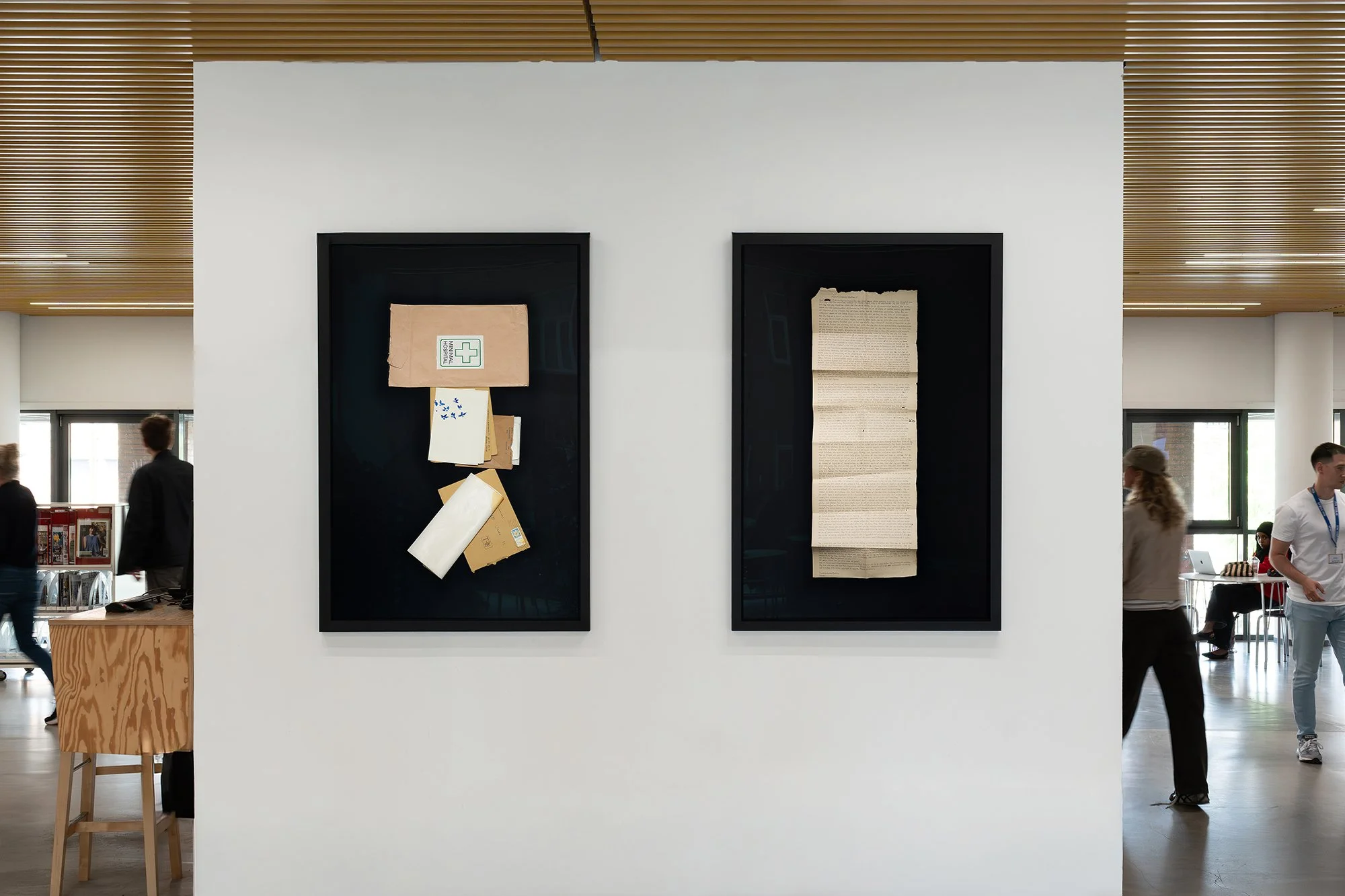
Left: Minimal Hospital, Right: Illumination, archival inkjet prints, 2026 © Victor Chakravarty
Suspended Forms & Spaces I, currently on view at Odense Central Library in Denmark, presents new work by Victor Chakravarty. It is the first of a two-part exhibition presented in public libraries, in which the artist addresses the contemporary condition of the letter as a medium of exchange amidst global digitalisation and the decline of physical mail volumes. In light of Denmark’s decision to discontinue letter delivery by its state-owned postal operator at the end of 2025, the exhibition is particularly prescient, as it examines histories of public infrastructures, questioning their role in shaping systems of communication, culture, labor and value.
The photographs, sculptures, and video installation that make up the exhibition all draw from the artist’s vast archive of personal correspondence, produced between 2007 and 2025 as a response to the rise of Facebook and other social networking services. In the process of reviewing and reworking the original material, Chakravarty reflects on rituals surrounding sending and receiving letters, treating them analytically rather than elegiacally. Working from within the historical moment of the decline of epistolary exchange, he considers the decision to end 400 years of postal history symptomatic of a broader corrosion of public life, driven by the extractive logic of techno-feudalism.
The infinite black backgrounds of Chakravarty’s large-scale photographs suggest a metaphysical depth that reaches beyond the two-dimensional image plane. In Minimal Hospital (2026), manila envelopes and folded papers have been arranged into a formal structure of geometrical equivalents. In another photograph, an oversized letter seems to give off an inner glow. Quietly miraculous, Illumination (2026) refers to Rimbaud’s unfinished collection of prose poems, as well as the history of gilded ornamentation in medieval manuscripts. By magnifying details of written communication materials, these photographs accentuate the physicality involved with writing, sending and receiving letters. They are part of a larger series that will be presented later this year in the second chapter of the exhibition.
Suspended Forms & Spaces I is installed in the middle of the library’s operational zones, which include reading rooms and civil services provided to city residents. The focused selection of works decidedly interrupts the building’s day-to-day traffic. A series of books selected by Chakravarty from the library’s collection is presented alongside the exhibition, including texts on communication and correspondence by James Baldwin, Karl Marx & Friedrich Engels, Clarice Lispector and H.C. Andersen.
Systematic ruins of history 1-5 (2026), a sculpture in five parts, is perhaps the most audacious of the works presented. According to the artist, the bricks that form small stacks arranged on the library floor are the same type as those used to build the last post office constructed in Denmark. Letters from the archive are sandwiched between the layered bricks, fixed and splattered with mortar, revealing fragments of text. Each component has its own sinuous form that invites an embodied reading at close range. The sculpture is both conceptually rich and playful — the juxtaposition of materials and their respective origins produces a curious tension between entropy and renewal. While grounded in the apparent decline of the letter, the work does not mourn its disappearance so much as imagine the conditions of its afterlife.
The video work Immediacy, or the end of physicality (2026), provides an idea of the scope of Chakravarty’s letter-writing practice and alludes to the labor involved in the trajectory of a piece of mail being sent from point A to point B. The hands of an anonymous figure are filmed from above as envelopes appear before them, one after another. Each is opened, its contents quickly inspected and slipped back inside before the next envelope enters the frame. As traditional postal work has diminished significantly in light of digital exchange and the expansion of parcel handling due to e-commerce, the task performed by the faceless character feels obsolete. The piece traces a broader transformation in the infrastructures of communication and labor, from the handling of physical messages by human hands, once central to the movement of information, to automated systems and the circulation of information across digital networks. As the artist sees it, this techno-feudal turn, in which cultural production becomes training material for proprietary AI systems, reproduces the exploitative mechanisms historically associated with colonialism.
In October 2026, Suspended Forms & Spaces II will open at DOKK1 in Aarhus, Scandinavia’s largest public library. Situated on the harbor, adjacent to Denmark’s busiest commercial port, the venue offers a fitting context for Chakravarty to extend the inquiries initiated in Odense. Among the works on view will be a new sculptural installation incorporating a monumental antique letter-sorting cabinet and a series of suspended photographs. Together, the two exhibitions consider the material and social infrastructures that sustain acts of communication, asking how forms of relation emerge, recede, and transform over time. At stake throughout is the question of what forms culture might take when the frameworks of communication pass from public institutions into private hands.
Text on Victor Chakravarty’s solo exhibition Suspended Forms & Spaces I at Odense Central Library.
Odense, Denmark
June 1 - July 1, 2026
Note: The publication of the final version of this essay is forthcoming in the French journal Entre-Temps (Collège de France).